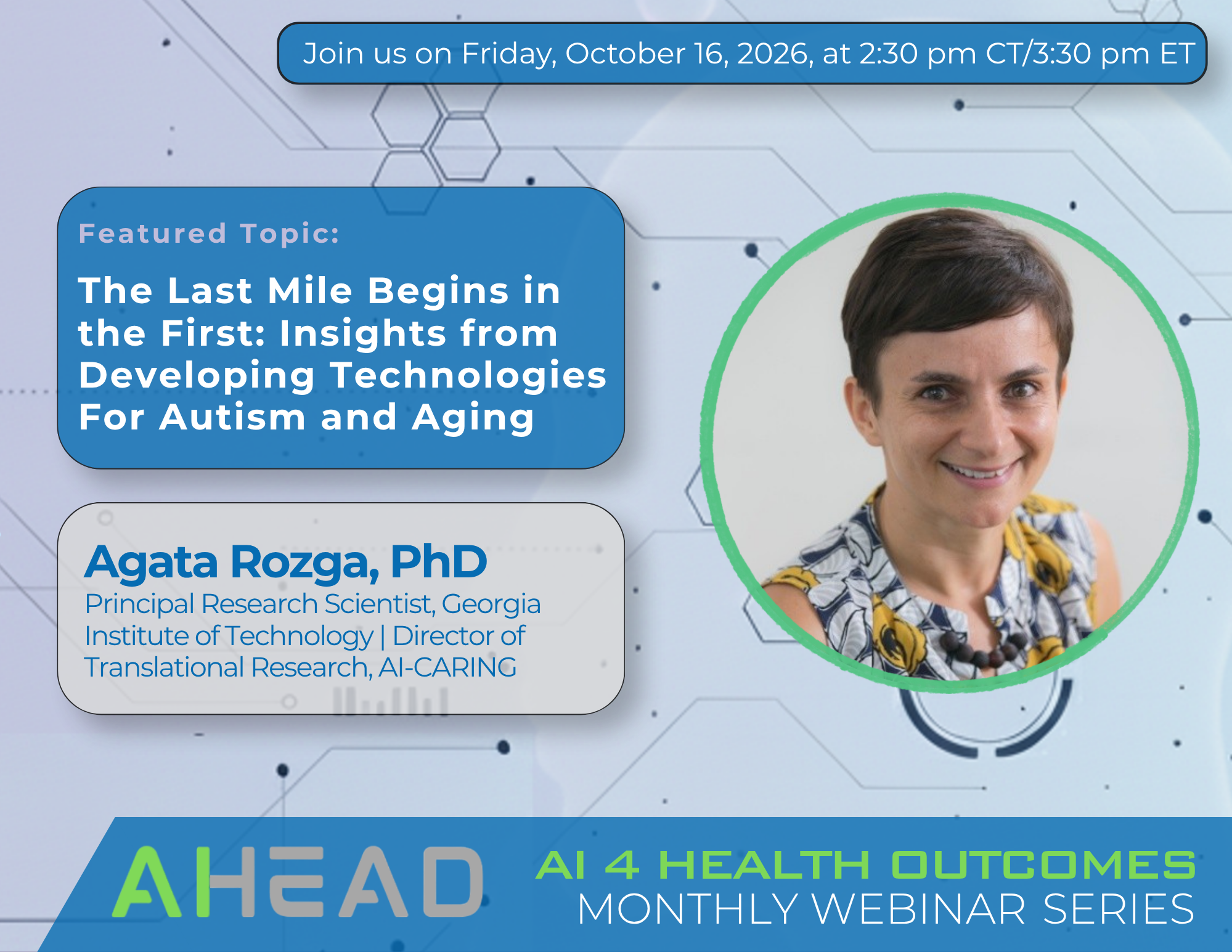

Agata Rozga, PhD.
Principal Research Scientist in the School of Interactive Computing at the Georgia Institute of Technology, and the Director of Translational Research for AI-CARING
Topic: The Last Mile Begins in the First: Insights from Developing Technologies For Autism and Aging
Date: Friday, October 16 2026
Time: 2:30 pm – 3:30 pm CT / 3:30 pm – 4:40 pm ET
► Register here – https://forms.office.com/r/w4Be170ByL
Biography: Dr. Rozga’s research sits at the intersection of health, AI, and human-centered computing. She develops novel tools and methods that can he used to study health behaviors in real-world settings, with a particular emphasis on behaviorally defined, progressive conditions such as autism and cognitive decline. She aims to bridge the gap between translational research and scalable technologies that improve the lives of individuals, their care partners, and providers. Her work in support of early detection of autism was commercialized in collaboration with Behavior Imaging Solutions.
Dr. Rozga previously served as Head of Human Centered Design and Head of Product for Diligent Robotics, a startup developing hospital service robots to support nursing, which was recently acquired by Serve Robotics.
AI-CARING is an NSF AI Institute focused on developing AI-based interactive technologies to support aging in place.
Project Overview: In this talk, I propose that the successful translation of predictive models and interactive technologies from research into healthcare settings begins with decisions and assumptions made early in the R&D process: decisions in how foundational models are trained and what is being predicted, assumptions about end users and their needs, as well as the settings and metrics used to evaluate early prototypes. I draw upon my work in autism and aging, which spans foundational AI, real-world deployments, and commercialization, to illustrate key lessons about theoretical and practical considerations in developing and evaluating AI technologies that can successfully bridge the translational gap.


Leave a Reply